Saturday, 29 December 2012

2012 in review


Looking back to the start of the summer, it seems odd to think that many West End theatres will have completely different shows in them by the start of summer 2013. For plays, which often only do a limited run, and musicals with short engagements, this isn’t that uncommon but 2012 has also seen many long-running shows either close or move. With Blood Brothers, Chicago, Ghost, The Wizard of Oz, Shrek the musical and Dreamboats and Petticoats either gone or soon to be gone and Mamma Mia having moved to the Novello, it seems that there is an excitement in theatreland of some fresh new shows coming in 2013.

Once again, subsidised and non-commercial theatre triumphed with the RSC’s Matilda the musical garnering a record 7 Olivier Awards at this year’s ceremony and the West Yorkshire Playhouse’s production of the new musical Loserville transferring to the West End (albeit for only a short-lived run). The Old Vic achieved great success with their first West End transfer in Noises Off and Shakespeare’s Globe’s productions of Richard III and Twelfth Night also gained five star reviews and transferred to the much-transformed Apollo. The National not only managed find new success in Alan Bennett’s latest play People and the West End bound Curious Incident of the Dog in the Night-Time but also produced much acclaimed productions of Timon of Athens and Collaborators, both proving popular in the awards’ ceremonies, with the critics and more importantly, audience members. Furthermore, they also continued their West End success with War Horse and One Man, Two Guvnors, the latter of which proved to be just as successful with a new leading man. Further afield, OM2G has embarked on an international tour, stormed Broadway and it has also been announced that War Horse will tour the UK next year as well.

The Royal Court is just about to finish off an extremely successful West End season at the Duke of York’s as well as producing new work with In Basildon, The River and Love and Information. Chichester Theatres have also had a successful year with their West End transfers of Sweeney Todd and Singin’ In The Rain and London transfer of Kiss Me, Kate, but it is a shame that The Resistible Rise of Arturo Ui, which was rumoured for transfer, didn’t happen thus leaving the Wyndham’s Theatre dark for a short period.

One of the most successful directors of the year is Lindsay Posner. With Noises Off, Abigail’s Party, Relatively Speaking and Uncle Vanya under his belt, all of which have been or will be in the West End, he has directed several nuanced and popular productions. Admittedly, Relatively Speaking hasn’t been widely reviewed yet and Uncle Vanya wasn’t much to shout about (despite Peter Hall allegedly thinking otherwise), his attention to detail and ability to direct a variety of productions is something of which to be proud. The acting ‘equivalent’ of him would be Jonathan Coy. Finishing 2011 with the West End Much Ado About Nothing, he went on to be in Noises Off at the Old Vic and Novello, is currently in The Magistrate at the National and will soon be returning to Relatively Speaking which toured this Autumn and will be at the Wyndham’s Theatre next summer.

It’s been a great year for acting as well, with there being plenty of performances to choose from and argue over in the upcoming awards’ season. Mark Rylance opened the year by playing Johnny Rooster Byron in Jerusalem and ends the year by playing Richard III and Olivia in Richard III and Twelfth Night respectively. We had summer blockbuster performances from Simon Russell Beale and Julie Walters at the National, Jonathan Pryce in King Lear at the Almeida as well as Danny DeVito and Richard Griffiths in West End.

Farce and comedy continued to be ever successful this year in the face of a recession and show no signs of slowing down. Indeed, 2013 will see Noises Off tour and Privates on Parade has only just opened. However, next year also sees a slight change in comedy offerings, more of which I will mention in my next blog entry. However, not every one was a success. The reaction to A Chorus of Disapproval seemed to be lukewarm and the all-star, all-commercial West End revival of Joe Orton’s 1960s’ controversial farce What the Butler Saw was a flop with the critics and the box office. However, the production did seem to take on a celebratory and British tone which reflected the patriotic mood of the summer. Alas, this didn’t quite bring in audiences though, much like many West End shows over the Olympic period, thus leading to closures. However, one show which didn’t close was Agatha Christie’s The Mousetrap which celebrated its 60th anniversary this November with an all-star cast for a special, one-off performance as well as launching a popular UK tour.

The summer also saw the announcement of the blockbuster 15 month run of the inaugural West End season of the Michael Grandage Company. Five plays made up of a mixture of new and classic plays, the season boasted 100 £10 seats on sale throughout the auditorium for each performance. Although these nearly sold out within the first 24 hours (apart from the day seats), it proved a popular scheme that was soon repeated in Trevor Nunn’s West End revival of Alan Ayckbourn’s A Chorus of Disapproval.

For regional theatre, where Sir Nicholas Hytner has raised his concerns that there might be struggles with the arts cuts, receiving houses have seen tours of musicals Oliver!, American Idiot, Phantom of the Opera, Blood Brothers, Lion King and many more. In terms of producing houses, Leicester’s Curve triumphed with the UK’s first major revival of Gypsy for many years as well as hosting the try-out run for the much publicised Finding Neverland, with the producer and movie mogul Harvey Weinstein proclaiming how impressive he found the theatre. Sheffield Theatres also had a successful end of the year with their production of My Fair Lady.

Here are my 2012 highlights:
1.      Blood Brothers, by Willy Russell, at the Phoenix Theatre – the ‘ultimate’/ final cast.
2.      Posh, by Laura Wade, presented by The Royal Court at the Duke of York’s Theatre.
3.      Noises Off, by Michael Frayn, at the Old Vic.
4.      Twelfth Night, by William Shakespeare, at Shakespeare’s Globe.
5.      Long Day’s Journey into Night, by Eugene O’Neill, on tour at the Theatre Royal, Nottingham, with particular mention to Laurie Metcalf’s and David Suchet’s performances.


Finding Neverland


Curve, Leicester
13th October, 2012

Let me start by saying that this is a fantastic piece of theatre. This highly anticipated new musical produced by Harvey Weinstein and based on the award-winning movie used Leicester’s Curve as a try-out run to develop it before hopefully transferring it to the West End and Broadway.

We join J.M. Barrie (played by Julian Ovenden) on the opening night of his new play The Wedding Guest which turns out to be a theatrical flop. Soon after, he meets the widowed Sylvia (Rosalie Craig) and her four boys. The six of them along with Barrie’s dog Porthos (played on stage by a real, show-stealing St. Bernard) form a bond and their adventures inspire Barrie’s new work Peter Pan, which turns out to be a success. It’s a post-modern piece of work, with references to other literary works of the time. Secondly its interest in performance seems to be in the zeitgeist at the moment. After all, we have had a whole host of movies such as The Artist, Hugo, Midnight in Paris, My Week with Marilyn and the upcoming Hitchcock as well as musical revivals on the cards for Gypsy and Barnum, so it seems that Finding Neverland’s awareness of performance and interest in ‘play-making’ could do well.

I was aware of how big Curve’s stage was and that it is also first rate when it comes to facilitating technical tricks and effects, but I was still extremely impressed by the aetheitcs of the whole show. A moving car, a staircase, the front of a pirate ship, a fireplace that reveals Captain Hook and a full projection of the façade to the Duke of York’s Theatre in London are just some of the many pieces of set. It certainly looks ready to go into a London theatre now.
However, there are still teething problems, namely the opening (which was reworked a number of times throughout the run at Curve) which seems not as strong as some of the other numbers in the show. Furthermore, there are only a couple of songs which are memorable and that might only be down to the near-incessant TV adverts that Curve were playing in the surrounding area, and perhaps enough is not made of Rosalie Craig’s superb voice.

Craig’s and Ovenden’s performances are both excellent, with their voices occasionally sending shivers down the spine. Ovenden in particular gives a strong and passionate performance as the ever-ambitious Barrie but I wonder if the audience ever fully emotionally invested in the characters.

The end of act one featured an unbelievable pirate ship sequence and the Captain Hook/ pirates vignette inside the study which featured acrobatic choreography was also extremely impressive.

Attending this Saturday evening performance was the singer Katherine Jenkins (who was probably the first person in the stalls to give a standing ovation) and someone who I think was an American producer sitting at the back of the stalls. Overall, for Finding Neverland to have much of a future (which I hope it does) it needs some re-writes and also needs to find a target audience as it certainly isn’t solely for children as some audience members might have thought.

A little end note: For any audience members wondering whether to go to Curve, I can assure you that the view from most parts of the auditorium is exceptional.

Finding Neverland ran at Curve from 22nd September to 18th October, 2012.

Hedda Gabler


Old Vic, London
27th September, 2012

After studying Henrik Ibsen’s A Doll’s House for A-Level, I’ve never been hugely engaged with his work and although I enjoyed his much more controversial play Hedda Gabler at the Old Vic, I still don’t quite see how his work is just as relevant today as it was in the late 19th century – no matter how many times the programme notes tell me.

The performances were all first class in Anna Mackmin’s new production, with Adrian Scarborough particularly impressing as Hedda’s husband George Tesman. He makes sure that he doesn’t convey a buffoon of a man, but instead portrays an intelligent, ambitious and loving husband with excellence. Anne Reid also nicely plays his aunt, injecting sometimes needed touches of humour. Daniel Lapaine’s performance in All My Sons in 2010 was brilliant, and he matches that in this just as short appearance in Hedda Gabler, giving a well-paced and passionate performance as the failed Loevberg.

Sheridan Smith does well at taking on the title role, renowned for being the female equivalent of Hamlet for its complexities. She successfully conveys the snappy, youthful independence of Hedda and strongly shows the turmoil that she goes through. The emotional scene where she burns her husband’s papers whilst in tears was particularly memorable but her performance didn’t have as much of an impact on me as I felt it should have done. Comparing it to some of the other great performances I’ve seen of complex, well-known characters, Smith’s didn’t quite live up to them.

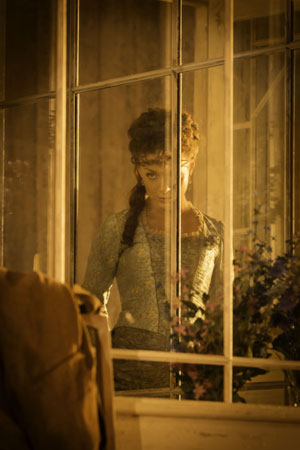
Lez Brotherston’s set was brilliant. The entrapment of addiction represented by the low-ceilinged set in Long Day’s Journey into Night earlier this year was shown in a completely different way in Hedda Gabler. The claustrophobia of Hedda’s world, where she feels governed in a patriarchal society, is reflected through a glass wall set that represents a prism. It goes back by quite a way and also contains a middle room where the fatal ending takes place. Indeed, the set feels light and airy but as Hedda shuts herself in that middle room for the play’s last moments, it represents how Hedda feels entrapped.

Paul Englishby’s music gave the production a cinematic quality that is fitting as the programme told us that Ibsen is best played with a heightened feel. Indeed, once Hedda has shot herself, the subsequent moments were played out in an-almost over the top manner. It’s extremely dramatic, watchable and in my opinion was one of the best moments of the production, even if some critics did disagree that Darrel D’Silva’s Judge smearing bloody hands down the glass door was a little too melodramatic.

Although this was an impressive new version (by Brian Friel), I wasn’t the only audience member in the Upper Circle who felt that the evening at some points was a little – dare I say – dull.

Hedda Gabler ran at the Old Vic until 10th November, 2012.

Friday, 28 December 2012

Betrayal


Crucible, Sheffield
2nd June, 2012

I didn’t see the much acclaimed 2011 West End production (starring Kristin Scott Thomas) of Harold Pinter’s most famous memory play, but after seeing Nick Bagnall’s revival I can’t imagine the play being produced in such a way that would be more effective than this. Firstly, the staging has a high impact: the Crucible’s thrust stage is turned into a glass round turntable, inspired by David Hockney’s Life on a Glass Table. The play’s mainly reverse chronology is reflected in the stage revolving anti-clockwise and then clockwise when time moves forward, being aided by projections showing the setting of each scene. Not only is this pleasing to watch but it also outlines the importance of how things change with time in a simple way and without appearing at all gimmicky.

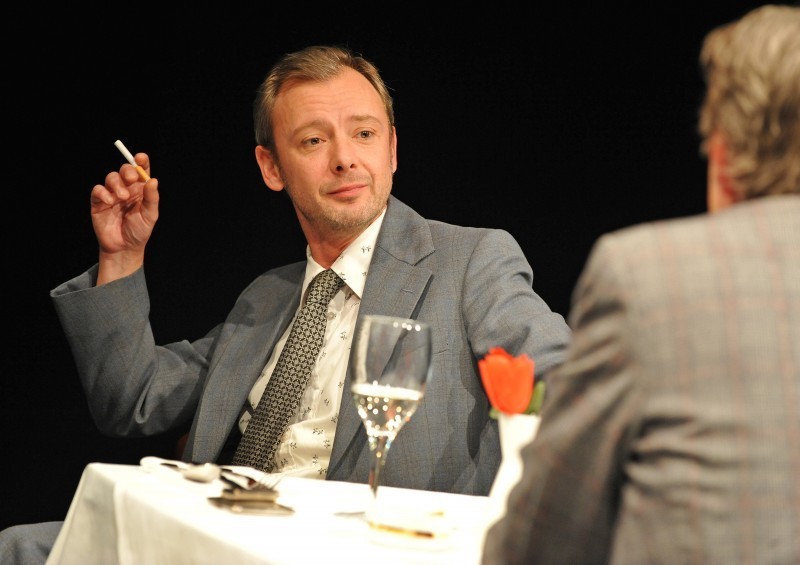
The audience can see underneath the transparent stage to see masses of love letters scattered about, suggesting that the act of betrayal that lies in Robert and Emma’s marriage is a mess as well as acting as a reminder of what has been done. However what are not transparent are the lives of Emma and Robert, the latter of whom has been cuckolded by his best friend Jerry. Ruth Gemmell, Colin Tierney and John Simm all give exceptional performances in this intense three-hander, drawing out moments of humour, passion and emotion from the script. Although I know little about Pinter’s work, I could tell that the most was made of the Pinter Pause, with Bagnall allowing for some near-excruciatingly long pauses, this heightening the intensity of many scenes.

I concur with other critics when some of them wanted more complexity in the three main characters although all three portrayed well-rounded, believable performances.  Furthermore, Thomas Tinker provided nice support as the waiter ensuring swift scene changes throughout.

Overall, Bagnall’s production had a moody atmosphere and proved for a powerful afternoon in the theatre.

Betrayal ran at the Crucible (part of Sheffield Theatres) from 17th May until 9th June, 2012.

Sweeney Todd


Adelphi, London
21st June, 2012

The West End transfer of Chichester Theatre’s production of Sweeney Todd stands as one of the musical highlights of 2012. It not only is gory but is also genuinely scary in moments and adds touches of humour, all played out by a wonderful and highly vocally talented cast on a detailed 1930s’ London set.

For this performance, I got a front row day seat for the stalls for a mere £24.99.

Before the musical starts, ensemble members of the cast come onto the stage from all directions and start to bring to life the grimmer sides of city life in London. Not only was I not expecting this, but at the start when Adam Pearce came down from a spiral staircase, I did begin to wonder whether he was part of the show or had just wandered on from the street. Giving a scary look across the stage and then sitting down and occasionally chuckling to himself, director Jonathan Kent assured that Pearce was completely watchable, which was fitting as he did have the first line of the show’s overture.

One of the issues brought on by having a three-tiered set is that the production did have some sightline problems. When I booked, I was told that being at the front and back of the stalls cuts off parts of the view although I wasn’t particularly affected. However, if you were sat in the centre of the front row, you will most likely have missed Epiphany where Todd and Lovett were brought forward on a raised platform that protruded the proscenium arch. However, what you will miss in facial expressions, you will gain in Ball’s fountains of spit that were being produced during it.

Some might say that Imelda Staunton’s Mrs. Lovett acts as comic relief in Jonathan Kent’s dark production, but she does more than that. Yes, she is extremely funny but also provides warmth, which is especially seen in her scream of ‘I love you’ in her final song when she shows how all of the murders and immoral acts were done for love and revenge. Therefore, although this may be a tall tale of fictional extremities, it is rooted in highly human experiences that we are all able to relate. For this, Staunton steals the show and slightly shadows Michael Ball’s performance as Sweeney Todd. Although he has dramatically changed his appearance and voice, putting on a London accent, to distance the charming TV and musical personality reputation that he’s built for himself, he still didn’t evoke a completely sinister, vengeful character. Instead, his performance suggested hints of his character’s former softer side which worked well and showed the amount of work put into developing his character. However, something still felt missing: the tap he gave to Imelda Staunton’s bottom at the end of the curtain call, for instance, swiftly brought back the Michael Ball we have all come to know. Overall, this suggested that the audience were left with memories that we weren’t presented with a dark and scary figure, but that instead it was just Michael Ball acting all along!

A fine supporting cast including Peter Polycarpou and John Burt and an excellent ensemble cast brilliantly demonstrated Sondheim’s tricky melodies as well as portraying well-rounded, thought-through characterisations. A great evening in the theatre.

Sweeney Todd played until 22nd September 2012. A cast recording is now available on CD and for download.

Thursday, 27 December 2012

One Man, Two Guvnors


Curve, Leicester
25th October, 2012

Although this was only the opening night of the UK tour of Nicholas Hytner’s award winning, highly acclaimed farce, itself an adaptation of Goldoni’s A Servant of Two Masters, I still felt that something was missing from it.

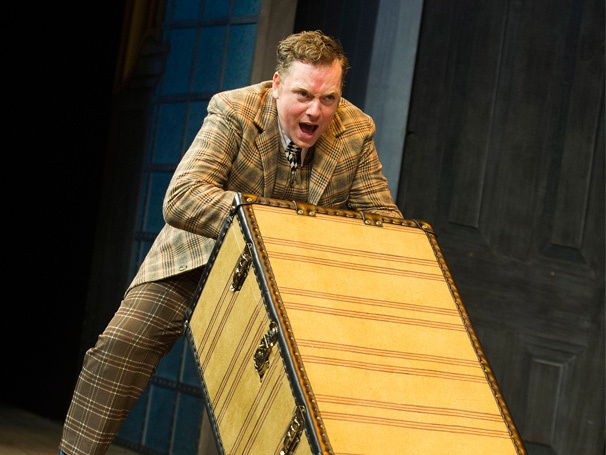
Francis Henshall has a problem. Easily confused and very hungry, he gets employed by two men and spends the play trying to keep the two from ever meeting as well as holding up both of his jobs. Rufus Hound takes on the role that James Corden created and although this was my first time (as well as Hound’s), I’ve seen enough clips of the play to feel that Hound didn’t quite do some moments justice. For instance, the scene where Henshall beats himself up lacked pace and didn’t quite build up to anything hilarious. No doubt that Hound will get better as the run goes along and I admit that I never really found the routine funny when Corden did it, Hound didn’t quite live up to his predecessor on the night. However, he coped with the improvisation sequences in the show with aplomb and plays the ‘cheeky chappy’ Henshall very well and also nicely captures his naivety – although that might have been down to first night nerves!

The rest of the cast all brilliantly played their roles. They went all out which is apt as this is a production that goes all out. It is not a parody or pastiche of 1960s, Carry-On style plays, this is a full-out take on that low-art, popular culture style of play. It makes no apologies and has no need to either, with Richard Bean’s script full of as many gags as there are physical ones.

Comparing it to Noises Off, as many have done, I felt that it wasn’t as well-rounded in terms of its plot, perhaps because of its episodic, sketch-like nature. The end of act one is by far the funniest part of the show but is probably not as funny as its London production as the disadvantage of a touring set is that it doesn’t easily allow you to have stairs going under the stage and so therefore no one falls down any stairs in this scene. Instead, a set of double swing doors allows for characters to repeatedly have their faces slammed into it. The stooge in the audience also made for a shocking but hilarious piece of theatre and allows for the style to fully go back to that of old British variety acts. Wonderfully done!

Supported well by a colourful set and costumes as the well as talented skipper band The Craze, One Man, Two Guvnors is not to be missed even though it doesn’t quite take to the comedic heights that I was expecting it to.

The National’s production of One Man, Two Guvnors is currently on its international tour and is in the West End (starring Owain Arthur) at the Theatre Royal, Haymarket booking until September 2013.

Noises Off


Old Vic and Novello, London
28th January and 20th June, 2012

Being hailed as the greatest farce of the 20th century, Lindsay Posner’s production of Michael Frayn’s backstage comedy is just as good as expected. The Old Vic made a brave move deciding to put on the ultimate farce in a theatre society saturated with comedies and farces at the moment but it proved to pay off as it was the first Old Vic production to transfer across the Thames into the West End.

The Old Vic’s scheme of selling £12 tickets for under-26 year olds allowed me to book only 6 days in advance and buy a front row centre seat for this hilarious comedy. When entering the auditorium, the set is on show: the interior for a country cottage for a terrible British sex farce Nothing On. The stage is set for act one which sees the final rehearsal for the doomed play, with actors still unsure what they’re doing, the set causing mishaps and a short-fused director who yearns for the RSC but has been landed instead with end-of-the-pier theatre. ‘Getting on, getting off. Getting the sardines on, getting the sardines off. That's farce. That's the theatre. That's life’ cries Robert Glenister’s brilliant portrayal of Lloyd Dallas as he joins the company on stage after spending most of act one in the auditorium. The dry humour in his performance is superb and he exemplifies what farce is all about: ordinary people in extraordinary situations. At the end of the day, they would all rather be somewhere else, but especially the director, even if he is sleeping with two of the company members. When seeing the production for the second at time, at the Novello, I noticed that he had a microphone for the parts in the auditorium, perhaps because the acoustics are different in the auditorium even though it is more intimate that the Old Vic’s, or maybe it was to stop Glenister from straining his voice as I did hear that he was struggling with vocal problems during the show’s run.

Celia Imrie as Dotty is also superb (as is the whole cast). She switches from a theatre ‘pro’ who has money in the show to the modest Mrs. Clackett in Nothing On. Janie Dee, Jonathan Coy (who is enjoying many a successful theatre run at the moment) Jamie Glover, Karl Johnson and Paul Ready also impress in playing their part to trying stop the show falling apart. Karl Johnson’s Selsdon plays the burglar in Nothing On although Selsdon spends half the time trying to get drunk and the other lamenting on a once-successful acting career. Jamie Glover expertly falls down stairs and hectically jumps up them with his laces tied and excels at playing an actor who is desperately trying to keep on going no matter what is put in his way to stop him. Anyone with experience with being involved in a production can relate (to some extent) what potentially go on behind the scenery.

Amy Nuttall excellently played the vacant Brooke (who spends most of the show in lingerie and looking for her contact lenses) as did Aisling Loftus as the overwhelmed ASM, Poppy. It was particularly impressive when she actually blushed when realising Selsdon was stood behind her.

The wonderful, highly nuanced, almost balletic second act is a piece of theatre to be proud of and displays some of the funniest pieces of physical comedy you will see in a play. The third act nicely completes it. We see ‘one last push’ at trying not to let Nothing On completely fall apart in the actors’ hands, but ultimately it does along with the set doing so as well. To top it all off, the theatre curtain falling on top of a mass of scrambling actors made for a brilliant end.

Noises Off played at the Old Vic over Christmas 2011-12 and then played at the Novello Theatre in the summer of 2012. The same production will be touring the UK in 2013 and it was recently picked as one of theatrical highlights of 2012 by The Guardian.