Thursday, 28 April 2022

Jerusalem

Apollo, London

23rd April, 2022, matinee


Mother, what is this dark place?’

And she replies ‘‘Tis England, my boy, England’


I was 19 when I first saw Jez Butterworth’s Jerusalem (2009) at the Apollo in 2011. For me, it was the play that sparked a love for going to see plays and in particular a fondness of Butterworth’s work. I was lucky to get a £10 ticket fairly easily that day but it didn’t surprise me to hear that people were queuing around the block and camping overnight to get tickets. Jerusalem captured a sense of urgency I hadn’t seen reflected elsewhere and hadn’t been able to articulate myself until that point. It struck a chord for me and a generation of other young audience members hungry to see it. Ian Rickson’s production now returns to the Apollo Theatre with all the vitality and urgency it had first time round.


It’s St George’s Day and Johnny ‘Rooster’ Byron is facing imminent eviction from his caravan on the edge of a Wiltshire forest. What has been a hangout spot for local teenagers, a sort of coming-of-age ritual through the generations, is now under threat following complaints from the nearby housing estate. It’s also the day of the Flintock county fair and the reigning May Queen has gone missing. It’s a magnificent play, one which touches on insecurities about Englishness, brings together the ancient and the contemporary, and contrasts the mythical with the tangible.


I’d forgotten how much of the action is taken up by characters telling and listening to stories about Rooster: tales of him being a daredevil motorcyclist, his miraculous conception, being born with his own teeth and a cloak, meeting a giant who built Stonehenge. Stories give Rooster his legendary status and you can often see through the bullshit to see Rooster for nothing more than a wastrel who lives in a caravan and is laughed at behind his back. As Davey puts it, ‘you’re sat in your brand-new house you’ve sweat your bollocks off to buy, and find out four hundred yards away there’s some ogre living in a wood’. But there are other times when audience and hangers-on alike can’t resist the allure of his storytelling. And they’re not all completely unbelievable. The story where Rooster recounts a recent kidnapping by four Nigerian traffic wardens from Swindon mixes the bizarre with such peculiar detail that you wonder why he would make something like that up. And even the utterly fantastical ones are backed up with tangible proof: the Mars Bar from his sexual encounter with the Spice Girls; the drum that the giant wore as an ear-ring. By the end Butterworth has the audience believing in giants too.


Questionable storytelling has been especially pertinent in the past ten years. After the coalition government of 2010, I seem to recall commentators saying that politics was no longer a two-horse race. I can’t help but lament we’ve gone backwards since then. Everything is so divisive now: you’re either left or right, leave or remain. In politics and in culture it seems there’s barely any room for nuance. And storytelling has been crucial to politics in that time. Brexit and political discourse have been dominated by stories relating to national identity, often imagined, romanticised and polarising. The stories told in Jerusalem feel more like a warning now about the stories we tell ourselves as a nation. Even earlier this year, Tory party chair Oliver Dowden told a conference:


As I walk with my children through the calm suburbia of Hertfordshire… I actually reflect on the great fortune we have to live in a nation defined by stability, security… and, yes, Conservatism.


Dowden’s implied vision of England – suburban, white, middle-class – is nightmarish. It implies a rigidity which is probably not too far off the seventy-eight new houses on the new estate in Jerusalem and which also feature in its sister play Parlour Song (also 2009). It’s this uniformity that Rooster protests: ‘Them houses is lovely, clean and spanking now. But come two, three summers, couple hard winters, those windows’ll peel’.


The play has gained a new-found relevance since its last London run. It also remains just as funny, exciting and heart-breaking as ever. The opening, arguably the best opening ten minutes of any play, is brilliantly theatrical. A midnight rave with the blasting of The Prodigy crashing against the hymn ‘Jerusalem’ is soon followed by Rylance sauntering out of the caravan, doing a handstand in a trough of water and downing a cocktail of milk, vodka and raw egg. Ultz’s set is wondrous: an American airstream caravan, real chickens in a pen beneath it, surrounded by real trees towering up into the rafters and a clearing made up of Coca-Cola chairs and other detritus. One slight difference I noticed since the last time was that there’s much more green algae on top of the caravan. Is the intention that it’s aged with the play? It’s as if Rooster never got evicted ten years ago and the caravan has sat in the clearing ever since. A new set of kids are hanging around Rooster, Ginger’s still there clinging on, and history’s repeating itself. Fascinating and all the more poignant if so.


Rylance and Crook are on top form reprising their roles, along with Alan David who is also back as The Professor. The new members of the cast, particularly the kids, all provide excellent support making the roles their own. Rylance’s performance is so physical but there are also moments of stillness which are just as memorable. One of them is where he’s recounting the story of meeting the 90-foot giant. Rooster comes quite far downstage and looks out into the audience and ends the story so softly: ‘I watched him walk clean across the land, north towards the motorway, until he was off in the distance like a pylon’. It’s a line which has gained new resonance since the production’s last outing. There’s a moment in Steven Spielberg’s The BFG (2016), starring Rylance in the title role, where the giant runs across the countryside alongside a line of pylons, itself probably echoing this line in the play. It’s testament to the greatness of the play, so full of cultural and literary allusions that it has brought about other reference points and gained new meanings since it was first produced.


We saw a preview performance on St George’s Day no less, and were delighted to get an extra Morris dance from Gerard Horan (Wesley) at the curtain call.


Jerusalem plays at the Apollo Theatre until 7th August.

Kemi Awoderu (Pea), Mark Rylance (Johnny "Rooster" Byron), Charlotte O'Leary (Tanya), Ed Kear (Davey) and Mackenzie Crook (Ginger)
© Simon Annand

The Homecoming


Curve, Leicester

27th April 2022

I decided she was

I could be wrong but I think this is the first time Pinter’s Tony award winning The Homecoming (1965) has been professionally performed in Leicester since a production at the Haymarket in 1996. It seems odd to me that, outside of London, Pinter revivals are few and far between. It’s pleasing to see, then, that Theatre Royal Bath has revived the play for a UK tour. Jamie Glover’s production, starring Keith Allen and Mathew Horne, nicely balances the surface realism with an underlying sense of threat.

We get a sense that the usual trappings of a domestic drama are being skewed from the off. Liz Ashcroft’s design is a 1960s house in the East End: period wallpaper, a staircase, a living room, a window. On its own, it could be the setting for the sort of family drama that Pinter started his career acting in. But Ashcroft subtly subverts this. The walls loom into the rafters as if dwarfing the characters below and even the large staircase creates a sense of unease with the landing light casting shadows behind it. We meet Max, the cantankerous, misogynistic patriarch of the family, pitched perfectly in Keith Allen’s performance, the third time he’s been in this play. His language is coarse, he boasts about his son Joey’s sexual scruples, and he antagonises his chauffeur brother (who I saw Allen play in Jamie Lloyd’s production in 2015). What’s interesting is that some plays have pseudo families made of strangers taking on familial roles. Here, we have a real family where the roles and relationships are distorted. When Max’s other son Teddy returns from a long break working in America with his wife Ruth, the turf war escalates.

Mathew Horne excels as Lenny. Underneath the banal language, he’s poised with an ambiguous danger which makes him unpredictable. This is most explicit in the scene where he first meets Ruth. But somehow, despite Lenny’s intimidating language and running rings around his prey, his new-found sister-in-law holds her own. Played with careful stillness by Shanaya Rafaat, the power play culminates in a battle over a glass of water which she wins. In the second act, Teddy watches on powerless as Ruth is kissed by his brothers. By the end, Teddy returns to America while Ruth stays with his family and has agreed for them to pimp her out. But, ultimately, who is in control here?

Glover’s production is certainly less stylised than Lloyd’s 60th anniversary revival. However, I questioned whether that stripped back production swamped some of the play’s subtleties. Here, the menace is subtler and I think Glover (himself an actor) gives the cast space to let the text come first. I felt we were really given a chance to enjoy Pinter’s language, its comedic contradictions and dark subtext. I personally prefer some of Pinter’s later plays, but this is a fine example of an early work which draws on the naturalistic tradition but to unleash what Michael Billington called a ‘startling territorial takeover’

The Homecoming plays at Curve, Leicester until 30th April and then tours until 21st May.

Sam Alexander, Keith Allen and Mathew Horne in The Homecoming
Credit: Manuel Harlan


Friday, 22 April 2022

Secret Blog: “The world turns. And it turns. And it moves and you don't. You're still here.”

15th October 2011. The day after my 19th birthday, I queued up on Shaftesbury Avenue for a day seat to see Jez Butterworth’s Jerusalem at the Apollo Theatre. The play was still in previews for its second West End run and had just returned from a Tony-winning engagement in New York.

I wasn’t too familiar with what the play was about but was aware of the hype that surrounded Mark Rylance’s performance as Johnny ‘Rooster’ Byron and the play itself. For me, it was the play that sparked a love for drama and new writing, and an interest in Butterworth’s plays which later became the subject of my Masters dissertation. When I heard that people had been queuing around the block and camping out overnight to get tickets, it didn’t surprise me. Jerusalem captured a sense of urgency I hadn’t seen reflected elsewhere and hadn’t been able to articulate myself until that point. As a coming of age play, as a political play (which was particularly heightened following the English riots that summer), and as a play about Englishness, it struck a chord for me and a generation of other young audience members hungry to see it.

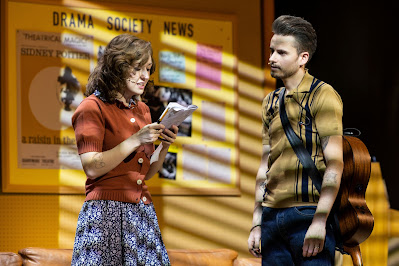
Tomorrow, 23rd April 2022 – St. George’s Day no less – I’m seeing the play again back at the Apollo where Mark Rylance and Mackenzie Crook have returned to their original roles. I’d just started my first year of university back in 2011. I’m now graduated, married and a home owner. I wonder how the play has also changed since then.

“Come, you giants!”


Wednesday, 20 April 2022

The Cher Show

 Curve, Leicester

19th April 2022


              Like a Cher doll


Our latest visit to Curve could seem like a case of deja vu – a show based on the life story and back catalogue of a normal girl growing up in the 1960s who becomes a musical powerhouse – the set up bears a striking resemblance to that of Beautiful, which we reviewed last month. But The Cher Show takes a much more bombastic approach to the biomusical, as befitting the vampy glamour of the queen of camp. Arlene Phillips’ new production (the European premiere) is a frothy concoction of corny jokes and power ballads, drenched in enough glitter to put the Strictly ballroom to shame.


The premise sees Cher (Debbie Kurup) about to go onstage for her farewell tour. Facing a crisis of confidence the singer addresses her younger selves (Danielle Steers and Millie O’Connell), delving into her past (or, ahem, wanting to ‘Turn Back Time’) in search of the lyrical meaning behind her comeback single ‘Believe’. It’s an interesting concept, which could draw comparisons with Albee’s Three Tall Women, but beyond this initial intrigue Rick Elice’s by-the-numbers book lacks the wit of similar biomusicals (eg. Douglas McGrath’s droll yet charming book for Beautiful) or the guts to go all out with the theatrical concept of the three Chers. The casting gimmick goes some way to mask the fact that Cher’s life story isn’t exactly a thrill a minute: we see her as a shy young girl meeting Sonny Bono (Lucas Rush) for the first time; together they scale the fame ladder with a few tiffs along the way; Cher eventually branches out on her own and takes her career into her own hands. The most dramatic moment comes when Cher’s young boyfriend, Rob Camiletti, punches a paparazzo – it’s not exactly high-stakes stuff and I didn’t feel like Elice provided any real insight into Cher’s character beyond the surface.


Despite the slightly clunky book, Phillips’ production uses the playful premise to maximum effect during the musical numbers, with the classic Cher vocals amplified threefold. Belters such as ‘Strong Enough’, ‘I Found Someone’ and ‘We All Sleep Alone’ are pumped out at full volume, showcasing the excellent vocals of the three leads as they strut around the stage in Gabriella Slade’s dazzling costumes. Tom Rogers’ set design also impressively propels the action: from New York subways to TV studio dressing rooms and the bright lights of Las Vegas, Rogers humorously incorporates dates into the minimal set pieces to ground the action in space and time. The music and book do occasionally come together to work some storytelling magic, and I especially enjoyed the section charting Cher’s acting career, set to the rhythm of ‘The Beat Goes On’. Kurup shines during these scenes, and Act 2 rightly belongs to her as she holds the audience in the palm of her hand.


While I wouldn’t class myself as a Cher fan, it’s easy to see why she is adored by so many – bold yet enigmatic, she remains a woman at the top of her game, and it’s refreshing to see the message of the musical reflected in the female-lead creative process of this production. The Cher Show doesn’t break any boundaries, but it’s a fun night out, filled with rocking songs performed to a high standard, and is an entertaining addition to the juke box musical genre.


The Cher Show plays at Curve, Leicester until 23rd April.

For further dates and tour details please visit: https://cheronstage.com/

Debbie Kurup as Star (centre) in The Cher Show, credit Pamela Raith


Friday, 4 March 2022

Beautiful - The Carole King Musical

Curve, Leicester

3rd March 2022


Sometimes, it goes the way you want, and sometimes it doesn't. And sometimes, when it doesn't, you find something beautiful


Singer-Songwriter Carole King delivers the above line at the top of the show sat at a piano in her 1971 concert at Carnegie Hall. The musical, which premiered on Broadway in 2014, then goes back to chart her early song-writing days, relationship with Gerry Goffin, and friendship with fellow songwriters Cynthia Weil and Barry Mann. We see King’s journey, from turning out hits at 1650 Broadway for the biggest household names to how she broke the mould of what a star can be. Nikolai Foster’s new production, which opened last night just weeks after King’s 80th birthday, shows that cultural shift with élan. Particularly impressive is that this is an actor-musician production which adds an extra level of authenticity and playfulness.


In the first act, we see King and Goffin writing songs for the likes of The Shirelles and The Drifters, and their friendly competition with Weil and Mann to write for those big artists. There’s so much joy in witnessing the magic-like quality of the song-writing process: King’s knack for melody with Goffin’s meaningful yet simple lyrics; the frustration of matching the right song with the right artist; their sleepless drive to make music. There’s a series of impressive set pieces including Weil and Mann’s ‘You’ve Lost that Lovin’ Feelin’’ being sung by The Righteous Brothers while Weil and Mann are jamming behind them on their sofa, and ‘The Locomotion’ performed on roller skates.


Although it’s the songs which stand out, Douglas McGrath’s book is first-class. It’s bubbly, full of observational one-liners and perfectly captures the New York vibe like a Neil Simon comedy. A particularly favourite line was when Mann likens moving in with Weil to his continuing audition for marriage. McGrath also cleverly builds in references to the cat and window seat from her album cover for Tapestry to show how King wanted to move away from the glitz and glamour of the New York scene. This is all played out on Frankie Bradshaw’s handsome recording studio set, with a proscenium arch made up of acoustic wall panels and everything stamped with [Property of 1650 Broadway]. Her design takes us from the studio’s functional hub of creativity to glitzy TV studios, Brooklyn apartments and Carnegie Hall. It marries well with Ben Cracknell’s lighting design – I especially enjoyed the effect of the plane landing in Los Angeles to mark that pivotal moment in King’s creative and personal life.


Molly-Grace Cutler not only captures the look and iconic raspy voice of Carole King, she encapsulates her spirit, humour and raw talent. But Foster’s production allows everyone to shine. Seren Sandham-Davies and Jos Slovick are a brilliant pairing as Cynthia and Barry: Cynthia’s self-confidence against Barry’s Woody Allen-esque awkwardness are played beautifully. Tom Milner adds depth with his portrayal of Gerry Goffin, capturing his creative frustrations and difficulties. Garry Robson also provides great support as the producer Donnie Kirshner.


It struck me that, if Dimension Records was a hit factory for music in the 60s, Curve could well be the theatrical equivalent of today. Beautiful is full of character, heart and great songs. It’s a sheer delight.


Beautiful plays at Curve, Leicester, until 12th March and then tours. It is a co-production between Curve, Theatre Royal Bath and Southampton’s Mayflower Theatre. For further information please visit https://www.curveonline.co.uk/whats-on/shows/beautiful-the-carole-king-musical/


Molly-Grace Cutler and Tom Milner in Beautiful - The Carole King Musical - Photography by Ellie Kurttz


Friday, 11 February 2022

Bedknobs and Broomsticks

 Curve, Leicester

10th February, 2022


Think of England


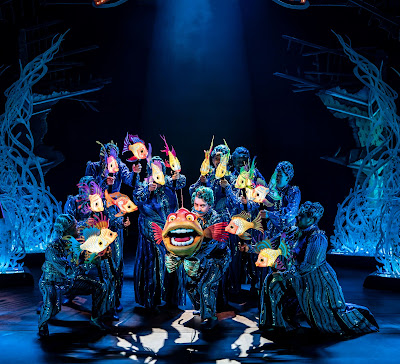
I’m surprised it’s taken so long to bring Bedknobs and Broomsticks to the stage. Based on Disney’s 1971 movie with songs by The Sherman Brothers, a stage adaptation would seem like a natural transition. Indeed, Chitty Chitty Bang Bang and Mary Poppins were among my first West End musicals. Chitty flying, the Child Catcher being snared to the roof of the Palladium, Mary flying over the audience, the proscenium walk, that house filling the stage of the Prince Edward… they are all indelible moments from my childhood which turned an interest in theatre into an obsession. Whilst the world premiere of Bedknobs and Broomsticks (produced by Michael Harrison) doesn’t quite reach the same heights, it certainly has its own style and charm which had the audience up on its feet at Curve last night.


Set in WWII England, Bedknobs and Broomsticks sees three siblings, recently orphaned after a bomb drops on their home, evacuated to the countryside where they are taken in by Miss. Eglantine Price, a trainee witch. The story takes them on a journey of flying beds, dancing clothes and talking animals as they go to the Island of Nopeepo. It’s a show about being betwixt and between worlds and the power of the imagination to escape. Whilst it features some impressive puppetry and set pieces, I can’t help but feel something is missing to make it really fly.


Jamie Harrison’s set and illusions are pure magic! The flying bed alone is enough to enthral audiences and inspire a new generation of theatregoers. Eglantine Price getting to grips with her broomstick before flying through the window into the night is also well done. Later in act one, as the music swells in ‘Portobello Road’, London’s skyline rises, market stalls wheel on, oil paintings fly in and streetlamps unfold. It is a particularly impressive sequence which conjures the energy of that market. My only hesitation about the design is that there’s so much of it! No sooner have the cast trucked on one piece of scenery they’re wheeling it off again. It’s true that this is part of the show’s frenetic energy, but I found it distracting at times.


It is all very slick, however, largely thanks to the tireless work of the company. Emma Thornett captures the prim and proper side of Miss. Price as well as the more comical moments really nicely. Robin Simões Da Silva also deserves a mention as Charlie Rawlins, conveying the sense of the older sibling stuck between childhood innocence and adult responsibilities. I was also struck by Sam Lupton’s performance as the con artist Emelius Browne, especially the number of quick sleight-of-hand tricks in his intro song ‘Emelius the Great’. And Rob Madge steals the scene with their puppetry skills as Norton, a charismatic northern fish.


With further distilling, there’s the potential for a big hit here. And looking at the audience last night, from young families to a gentleman sat nearby celebrating his 83rd birthday, Bedknobs and Broomsticks appeals to all ages, whether you’re revisiting it for reasons of nostalgia or coming to the story afresh.

Rob Madge and the cast of Bedknobs and Broomsticks. Credit: Johan Persson.


Bedknobs and Broomsticks plays at Curve, Leicester until 13th February as part of a UK tour running until May. For more information please visit Bedknobs and Broomsticks the Musical UK Tour 2021/22 | Disney UK | Disney Tickets UK


Thursday, 27 January 2022

Spring Awakening

 Almeida

22nd January 2022, matinee


It's cold in these bones
of a man and a child


I never got to see the original award-winning production of Spring Awakening, but in my lonely teenage years I had the cast recording playing on an endless loop and sought out all the bootleg videos I could find on YouTube – I thought I knew the musical inside out, and of course, like many other MT-obsessed adolescents in the late noughties, it spoke to me deeply. Now, revisiting Spring Awakening more than a decade later I realise that it is so much more than the ‘ultimate teen angst musical’ it’s purported to be. Steven Sater and Duncan Sheik’s musical is abundant with relevancies to audiences young and old alike. And while teens may feel the immediacy of its themes with the painful intensity preserved for the young, I can now see that it is also older generations – and indeed future generations – that must pay heed to its message.

In one sense, Spring Awakening is about the conflict between childhood and adulthood. Sater and Sheik capture the exquisite melancholia of growing up and the multitude of confusing, thrilling and horrifying feelings we all feel during adolescence. This is especially poignant in the Act 2 opening number, ‘There Once Was A Pirate’, which has been reintroduced in this production. While the musical covers difficult subjects surrounding physical, sexual and emotional abuse, the other overriding motif is the silencing of young people. As the characters try to make sense of – and question – the world around them they are repeatedly supressed and belittled by the adults in their lives that should be the ones guiding them. The frequency with which young peoples’ thoughts and actions are dismissed resonates still in a time where Gen Z and Millennials are being short-changed, ridiculed and scape-goated by the older generations in positions of power. ‘All That’s Known’ posits that ‘everything you say is just another bad about you’, highlighting the lack of communication and resulting wars between generations; a sentiment revisited in ‘Totally Fucked’ which perfectly echoes Greta Thunberg’s recent statement on world leaders’ position on climate change – ‘blah, blah, blah’. Rupert Goold’s protraction of this number is a masterstroke, the lingering awkwardness as the song peters out while the young cast fiercely stare down the audience is one of the most striking images of the production. Stunned into silence, there was no applause.

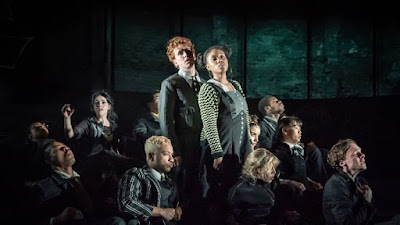
As such, Rupert Goold has rejected much of the whimsy of the original Broadway and London productions, in favour of a starker exploration of the purgatory of adolescence, in which the characters are trapped within a childhood dictated by unfeeling adults. This is consolidated by Miriam Buether (set) and Nicky Gillibrand’s (costume) assured design. The Tim Burton-esque monochrome aesthetic is chic, while also providing an apt framing device. By placing the young characters literally within a blackboard setting we see how the adult characters perceive them through a lens filtered by academic achievement and strict societal ‘rules’. Unnamed, bemasked and bewigged, the anonymous grown-ups are consolidated into a force of universal oppression. Yet the scholastic set also becomes an apparatus of rebellion when the characters pick up the chalk and annotate the world around them.

I particularly enjoyed Lynne Page’s choreography, which is punchy and humorous in the ensemble numbers (who doesn’t enjoy a well-timed hip-thrust in ‘The Bitch of Living’?!), while the combination of sensuousness and innocence in ‘The Word of Your Body’ is especially touching. The performances are uniformly excellent; Goold has assembled a fine ensemble of up-and-coming young actors that are indefatigable in their energy and show a passionate dedication to the piece. Nathan Armarkwei-Laryea’s Hanschen is genuinely funny and charming and Carly-Sophia Davies offers a fresh and edgy portrayal of the nomadic and troubled Ilse. I admired the quiet despair brought to Moritz by Stuart Thompson (also a stand-out in the recent National Theatre production of A Taste of Honey); his understated performance is heart-breaking, especially in the gently weary way he confronts his fate in the ‘Don’t Do Sadness/Blue Wind’ scene. Amara Okereke also gives a beautifully subtle performance as the sweetly naïve Wendla, and Laurie Kynaston leads with natural charisma, capturing Melchior’s intellectual anguish, earnest radicalism and boyish exuberance with great heart.

Spring Awakening may seem to be full of despair – and, to be fair, in our current political and social climate it’s difficult not to agree with such nihilistic sentiments – but the musical is not bereft of hope. In one of musical theatre’s most beautiful finales we are reminded that life continues, generations will grow, learn and prosper, and the pains endured in the pursuit of maturity are all threads in the rich tapestry of life. Yes, the plot is hard-hitting and damning, but we can all learn a thing or two about hope, change and empathy by looking to the past in remembrance of the future. This is a stunning production of a timely musical.

Spring Awakening plays at the Almeida theatre until 29th January 2022. 

The cast of Spring Awakening.
Credit: Marc Brenner